buxtononline.net

Buxton Online - An Independent Guide to the Peak District - Derbyshire


Search this site :


If you have a non-profit or Charity event to announce, please contact Buxton Online : info@buxtononline.net

ICRA Rating


Follow Buxton Online:
Buxton Online on Flickr Buxton Online on Facebook


The Quadrant
December Snow


Derbyshire's Peak District National Park covers an area of more than 1,438 sq kms and encompasses what is commonly known as the White and Dark Peaks. As Britain's very first National Park, it was established in 1951 and although primarily situated in the County of Derbyshire, it also falls within parts of the nearby counties of Staffordshire, Cheshire, Lancashire and Yorkshire.

Today, more than twenty million people live within easy reach of the Park's boundary, with many more than this visiting the area from all around the world every year. The unofficial Capital of the National Park is the attractive busy market town of Bakewell, which straddles both the River Wye and the main A6 trunk road between Buxton and Derby.


Although not actually situated within the National Park itself, the beautiful Spa town of Buxton is the largest habitation that lies within what is widely know as, The Peak District, where it is possibly one of the best centres to base a short, or even long term stay within the area. Buxton not only has direct access to Manchester Airport with flights to almost any point around the world, but also Rail and Road links that connect it with the rest of the country.

The Peak District is renown for its natural stunning landscapes, from the Dark Peak which lies towards the north and west, and rises to over 636m on the bleak windswept moorland around Kinder Scout, down to where it meets the northern edge of the White Peak at 200m in Castleton.

The Winnats Pass - Castleton

Peveril Castle - Castleton

It is here that the White Peak comes into its own, the historic remains of the Norman edifice that is Peveril Castle, sits perched on its towering buttress of limestone, standing out like a sentinel guarding the enormous gaping mouth of Peak Cavern, wherein lies the former testimony to the rope makers art, and Britain's deepest known cavern, Titan.

As if to shout in defiance, the shivering mountain known as Mam Tor provides a spectacular and lofty gritstone peak complete with its Iron Age Hillfort which reaches up to 517m, where it appears to be guarding any exit out of the Hope valley to the west. Such breath-taking beauty is but a tiny example of what the Peak District has waiting in store for the visitor.


For shear variety, the Peak District offers more to the Walker than anything else. There are rivers galore wending their way through magnificent scenic valleys. Begin by exploring the famous River Dove, the anglers' paradise and its sister, the Manifold, both have their origins just south-west of Buxton.

Then there is the mighty River Wye whose course threads its way through superb high limestone buttresses, made popular as meccas for climbers with its riverside walks that take you through Cheedale, Millersdale, Cressbrook Dale, Ashford in the Water and Bakewell.

Eventually, the Wye flows into the more mature River Derwent a long way from its beginnings in the Dark Peak to the north. From Rowsley, the Derwent flows all the way through Darley Dale, twisting and turning until it reaches Matlock, then on though Little Switzerland, or Matlock Bath to give it its true name, where after it passes close to the village of Cromford.

Bakewell Bridge
Bakewell Bridge

Millers' Dale
Millers' Dale
Upper Goyt Valley
Upper Goyt Valley

St Anne's Well
St Anne's Well

Another River, the Goyt, has been rightfully afforded the designation of being given the status of SSSI, a Site of Special Scientific Interest and wholly protected by law. Here on the moorland to the west of Buxton, lies the Goyt Valley and its magnificent stunning scenery, an area that is unrivalled in the Dark Peak.

Other minor rivers, but no less interesting where the walker is concerned, are the Lathkill, the Bradford and the Hamps, all of which are situated within the beautiful White Peak.

Both the Derbyshire Peak District and the Peak District National Park are filled with much of historical interest, some of which dates back several thousand years. For its architecture, the Spa town of Buxton wears the crown, offering the visitor the magnificent Georgian Crescent and the Devonshire, now a University building whose great dome is one of the largest unsupported of its kind in Europe.

When Buxton's Crescent was built in the late eighteenth century, the Duke of Devonshire utilized it as a means by which tens of thousands of visitors would have somewhere to stay, and at the same time take the natural spring waters for its curative properties. This water, with its high mineral content, now flows freely from the Well of St Anne which is situated beside the old Victorian Pump Room.


When the Romans originally came to Britain with their legions, they immediately began to set up a huge network of roads, military forts and smaller installations. While they were exploring the Peak District, the Romans discovered a wealth of minerals which they naturally exploited.

Further, they made use of the few people that lived within the region, and along with those they had brought with them, they put them all to work as slaves in their mines. When the great Roman Empire finally collapsed, they fled homeward leaving everything to the local people who eventually took back what was rightfully theirs, the land and its resources, including the vast wealth of minerals.

When the Turnpike era began during the eighteenth century, it marked a veritable revolution for those who liked to travel around the country. These new toll roads opened up the whole area, and just like the Romans and their own network of roads, these turnpike routes forged important commercial and social links between many of today's most popularly visited Peakland towns and villages.

Thus, larger towns such as Buxton, began to develop themselves as centres from which the attractions of the Peak District hills and dales could be explored more readily.

Blue John Stone
Blue John Stone

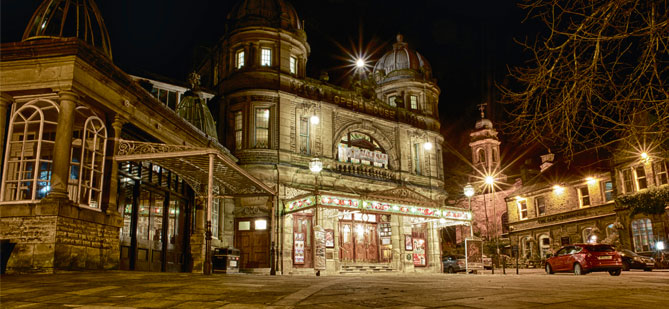
Opera House - Buxton

Well Dressing
Well Dressing

Ancient customs now play a very important role in many of the Peak District's towns, villages and hamlets during the long summer months. The most popular and widespread of all these events, is the mystical, ancient and very beautiful floral tradition known as, Wells Dressing.

Throughout the Peak District, there is also a great deal of charm and breath-taking beauty just waiting to be discovered in many towns and villages, like: Ashford in the Water, Bakewell, Bradwell, Chapel-En-Le-Frith, Castleton, Eyam, Hartington, Hulme End, Matlock and Matlock Bath, Tideswell and Whaley Bridge to name but a few. Most will provide the visitor with a variety of shops, selling anything from books to the latest in fashions, handmade and electrical goods to quality local souvenirs. Everyone can enjoy the Peak experience wherever they go.


Whether the visitor chooses to stay here for a day, or perhaps a week or two, they will discover a wide variety of the finest Accommodation that Derbyshire's Peak District has to offer. In order to meet with the ever demanding needs of the visitor : there are many excellent quality hotels, homely guest houses, country farmhouses, a variety of self-catering holiday homes everywhere, and a selection of camping and caravanning sites. The area also boasts a number of comfortable Youth Hostels, each set deep in the heart of the countryside and available for those who enjoy the advantages of perhaps, this more social form of budget accommodation. Regardless of your needs, there is something to suit just about everyone here in the Derbyshire Peak District.

The Buxton Online web site is now in its ninth successful year, and is very proud to have been able to welcome the 350,000+ unique visitors that it alone receives annually.

The many photographs on display are offered as a taster for what the visitor will discover for themselves, but for its shear beauty, no image can possibly take the place of the real thing. This truly has to be experienced.

The Seven Domes of Buxton


Disclaimer: Whilst every endeavour is made to ensure the accuracy of the information displayed on this website, the owners cannot be held responsible for any mistakes found therein.

Buxton Market Place
Market Place
Pavilion Gardens
Pavilion Gardens
The Crescent - Buxton
The Crescent
Website designed and maintained by Buxton Online